PLYMOUTH, Mass. – As there often is, a visit to a golf course was on the agenda for this brilliant October day, only it wasn’t per usual. The clubs stayed in the trunk, so did the golf shoes, and the sense of enthusiasm as the first tee approached wasn’t there like normally it is.
That’s because on this day, the 15th of October, with Autumnus – the Latin word for this glorious season – in full glory, something even more fun than golf was planned for this visit to Southers Marsh Golf Club.
At the coziest golf course under the sun, where you swear to goodness you can hear the “Cheers” lyrics as you arrive – Sometimes you wanna go where everybody knows you name / And they’re always glad you came – it was a day to harvest cranberries.
Actually, edit that. It was a day for Will Stearns and his dynamic crew of friends and relatives to harvest the cranberries. Yours truly merely watched, though J.D. Marks, who is married to Will’s sister, Betsy, was kind enough to offer waders.
Tempting as that was, the decision was made to keep my notebook and pen dry and afford myself plenty of time to ponder this wonder called Southers Marsh. It is home-built, created by two men with imagination and a quest for fun, Will Bramhall Stearns III who joined his father, William Bramhall Jr., in farming these cranberry bogs for years.
It was William Bramhall Stearns Jr. who in another era reached down to pull his 11-year-old grandson out of a ditch. “I was up to here,” said Will IV, laughing and holding a finger to his mid-chest area. “It was my first cranberry harvest experience.”
Grandfather, father, son. Will Stearns times three equals infinite genuineness. They farmed these berries every fall but the 13 bogs took up about 30 acres and when they looked at the land that they still had, they figured why not build some golf holes. None of them were golfers, but who cares?
“We had a blast on those few holes,” said young Will. “It was the most fun we ever had.”
When Big Will, Young Will’s dad, decided they should create a complete, 18-hole course, the exchange between two men is cemented into Southers Marsh legend.
“So, let me get this straight,” said Dahn Tibbetts, a golf-course shaper said to Big Will in 1999. “You’re going to build a golf course, but you have no help, and you don’t have any money?”
Nodding his head with a smile that he seemingly always wore, Big Will said, “Yeah, pretty much.”
And thus was a miracle of sorts put in motion because a few years later, the Southers Marsh experience opened to rave reviews. It was a cozy par-61 of 4,441 yards, fun to play, fun to be around, and in a world of golf courses that seemingly take themselves too seriously, Southers Marsh was affordable by miles and enchanting by incredible levels.
Twenty-five years later it remains as unpretentious as ever and no time of year accentuates its home-spun feel more than the cranberry harvest. To gather the berries in the 13 bogs on the golf course, plus a handful of others a mile down the road, Will Stearns galvanizes those he trusts implicitly and therein rests a layer of the Southers Marsh story that is most compelling.
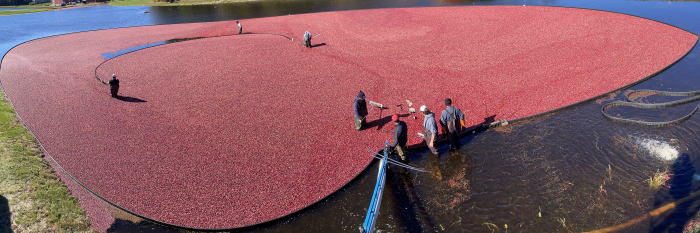
With precision and teamwork, the crew uses outer and inner booms to keep the berries sectioned off and gently steer them into the blue suction tube . . . where they are pushed up into a truck so be collected, cleaned, and eventually moved into a truck under the watchful eye of Will Stearns (below). Oh, and while rounds of golf play through.
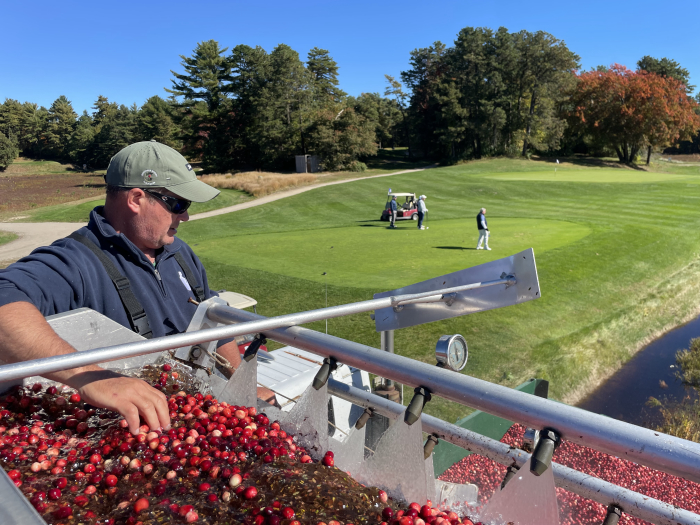
Loyalty runs layers deep down here, camaraderie is as present as air, and there is an unmistakable sense of pride that the golf course runs as smoothly as it does and the month-long cranberry harvest doesn’t really interrupt play. Matter of fact, it does the opposite; it provided plenty of entertainment for the golfers as they moved toward the third tee, 16th green, and 17th tee.
At least that was the area on this day, since that was bog being farmed. J.D. Marks, of course, was front and center, and so were the Zupperolis, Paul and his sons, Nick and Jonathan.
“I coached them in hockey,” said Will, “and Paul’s been a friend forever.”
Bob Adams is a member at Southers Marsh but he asked if he could be part of the cranberry crew and Graham Bouthillier, another longtime golfer, lives on the property now and he wasn’t going to miss the farm experience.
But what truly ties this generational work together is the presence of Mike Pruett and Jeff Utt, guys who had been two of Big Will’s closest friends.
How close?
“You see that house,” said Mike, pointing to a house maybe a driver and 8-iron away. “Big Will sold me that house on a handshake.”
Indeed, there once was a handshake-and-hard-work era in this country. Big Will was of that time and now here is Young Will carrying on in a similar fashion. The folks who do the cranberry harvesting also either work or play their golf here. Sort of chokes you up, because it’s real down here. It’s the sort of place where if an emergency call is made, perhaps two dozen folks would be there in five minutes.
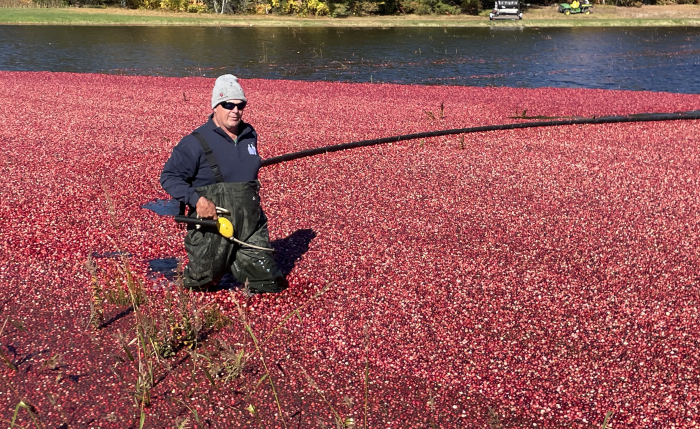
On this day, there were about six of them up to their knees in water, while Mike Pruett worked the controls in a pickup truck that would eventually hold 40,000 pounds of cranberries. How the berries got from the bog into the truck was owed to some gentle synchronization as the men worked hand-held booms to steer a big circle of the little red prizes into a suction tube.
From there they would go into a device . . . well, it had me thinking of Christopher Lloyd’s “Doc” Brown character who built a Flux Capacitor in the epic Back To The Future.
Primitive? Home made? Young Will nodded, then smiled. He conceded that improvements and improvises are always being made to this cranberry pump atop a pump truck. But as he climbed the ladder and prepared for a rush of cranberries to be sucked up through the tube, run through a collector, cleaned, and separated before being pushed into the pickup truck, Will Stearns spoke to the sort of experience that has built his character.
“Back when it was a dry harvest it was demanding work,” he said. It meant pushing a machine to shake the berries from the vines “and having someone come along and put the berries in a basket.”
But technology improved and in the mid-1980s “a water harvest was a game-changer.”
Now one bog at a time is flooded and a machine goes in and pulls berries loose. Unlike in those days of a dry harvest, the berries in a water harvest float to the surface. A stunning sight, and while even a guy like J.D. Marks has seen it for years he never gets tired of the stark contrast of bright, red berries against a backdrop of pulsating green grass and bright blue sky.
“Beautiful, isn’t it,” he said, showing a photo of that same pond earlier in the day. He was not wrong.
Only now, with a second truck loaded up, 80,000 pounds of cranberries had been harvested and packed into trucks that would be driven to an Ocean Spray location for weighing and delivery.
To Young Will and J.D. Marks, Mike Pruett, Bob Adams, the Zupperolis, and Graham Bouthillier, that day had been a successful one and one more X had been put on the calendar. “I really want to be finished before Halloween,” said Will, explaining that there a few more bogs at Southers Marsh, then a few others just down the road.
Throughout the day, Will had marveled at the site of so many golfers and he exchanged waves with nearly all of them.
“When we first opened, by October 1 the season was over,” he said. “Now, it’s packed and the game is so healthy.”
He spilled into my life in a most serendipitous way Will Stearns did, introduced by a mutual friend, John Mineck, who was a quintessential renaissance man and thought the entire Southers Marsh project reflected on the goodness and character of the Stearns family.
Will, of course, would tell you it reflects on an uncanny close circle of family and friends and that legion of loyal golfers who call it home.
Methinks they’re both right and whether you think it’s a golf course where they farm cranberries or a cranberry farm where they play golf, Southers Marsh is a canvas of Americana.